Skip to content
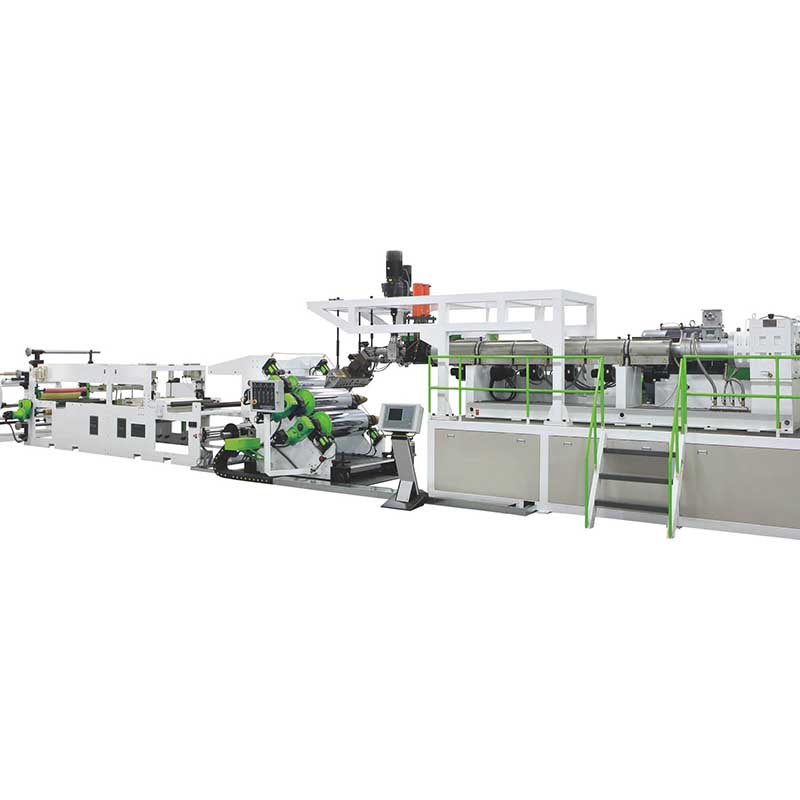
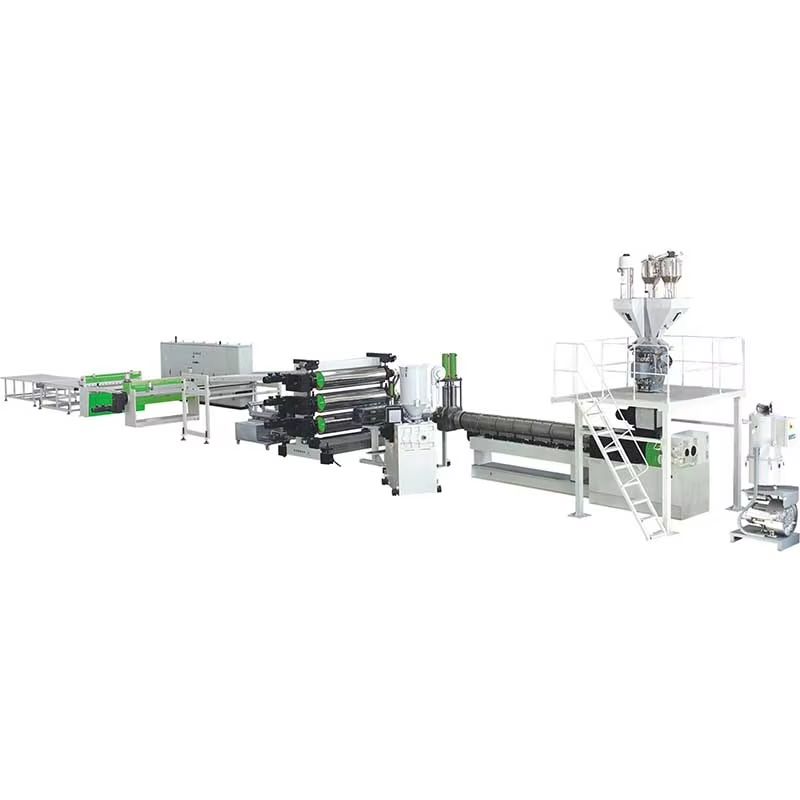
 Solar Film Extrusion Line serves as the core manufacturing equipment for solar film (mainly EVA and POE Film). Through standardized and automated processes, the complete production line transforms polymer raw materials into solar film with high light transmittance, weather resistance, and UV resistance, making it an indispensable part of the PV module production chain.
The complete production line is functionally divided into six parts: the raw material handling unit, extrusion molding unit, cooling and setting unit, haul-off and trimming unit, winding and storage unit, and the intelligent control system. All components work in tandem to ensure the stable production and quality control of the solar film.
Raw materials for solar film (EVA/POE pellets) must first undergo dehumidification and drying to control the moisture content below 0.02%, which prevents the formation of bubbles during extrusion that would otherwise compromise light transmittance. Then, additives such as anti-aging agents, crosslinking agents, and UV absorbers are added in accordance with the formula and thoroughly mixed in a blender. Mixture is subsequently precisely conveyed to the extruder hopper via an automatic feeding system, with the entire process conducted in a closed environment to minimize raw material contamination.
This constitutes the core section of the production line. Extruder heats the mixed raw materials to a molten state (the temperature is controlled within a low range of 90–110℃ to prevent premature cross-linking of the materials). The melt metering pump precisely controls the discharge rate to ensure the uniform thickness of the solar film. T-die is designed with a precision runner system, which evenly spreads the molten material into a film shape; the die gap can be flexibly adjusted according to the required film thickness (typically 0.30–0.80mm).
This constitutes the core section of the production line. Extruder heats the mixed raw materials to a molten state (the temperature is controlled within a low range of 90–110℃ to prevent premature cross-linking of the materials). The melt metering pump precisely controls the discharge rate to ensure the uniform thickness of the solar film. T-die is designed with a precision runner system, which evenly spreads the molten material into a film shape; the die gap can be flexibly adjusted according to the required film thickness (typically 0.30–0.80mm).
The haul-off unit pulls the shaped film at a constant speed to ensure the stable running speed of the production line. Online thickness gauge monitors the film thickness in real time with an accuracy of ±0.005mm, and the data is fed back to the control system for dynamic adjustments. The trimmer cuts off the irregular edges of the film to ensure a consistent width of the finished film.
Winder winds the film into a standard roll under constant tension; tension control prevents the film from stretching or wrinkling. Some production lines are equipped with a laminating unit, which applies a protective film to the surface of the film to avoid scratches during subsequent storage and transportation. The finished roll can be directly delivered to the production process of photovoltaic module manufacturers.
Full-line automated control is achieved, allowing for the setting and storage of process parameters such as extrusion temperature, haul-off speed, and winding tension. The system supports fault early warning and data traceability; some high-end production lines are equipped with remote operation and maintenance functions, enabling real-time monitoring of production status and remote debugging.
The final product of the solar film extrusion line is the photovoltaic encapsulation film. This film serves as the “heart protection film” of the photovoltaic module. Its application scenarios are entirely centered around the photovoltaic industry and can be classified into the following three categories:
Crystalline silicon modules are the mainstream products in the current PV market, accounting for over 90% of the total market share.
The EVA/POE films produced by the production line are used for encapsulating crystalline silicon cells, serving to fix the cells in place, transmit and guide light, and isolate moisture and ultraviolet rays. These films directly determine the power generation efficiency and service life of PV modules (conventional modules are required to have a service life of more than 25 years). Applicable Scenarios: Ground-mounted centralized PV power stations, commercial and industrial distributed PV systems, and residential rooftop PV systems.
To meet the encapsulation requirements of thin-film solar cells, some production lines can be customized to manufacture ultra-thin and highly flexible encapsulant film, satisfying the lightweight and bendable characteristics of thin-film modules.
Applicable Scenarios: Building-Integrated Photovoltaics, flexible PV carports, and portable photovoltaic devices.
With the diversified development of photovoltaic technologies, the production line can produce special encapsulant films with anti-PID, high temperature, and humidity resistance, and high barrier properties by adjusting formulations and process parameters.
Applicable Scenarios: PV power stations in harsh environments such as high-altitude, high-humidity, and high-salt-spray areas; bifacial PV modules; shingled high-efficiency PV modules.
We have supplied extrusion machines to multiple leading solar film manufacturers in China (e.g., Risen Energy Co., Ltd, JA Solar Technology Co., Ltd, HIUV New Material Co., Ltd, Crown Advanced New Material Co., Ltd, LuShan New Material Co., Ltd ).
Benchmarking customer needs, linking professional resources and services