 Skip to content
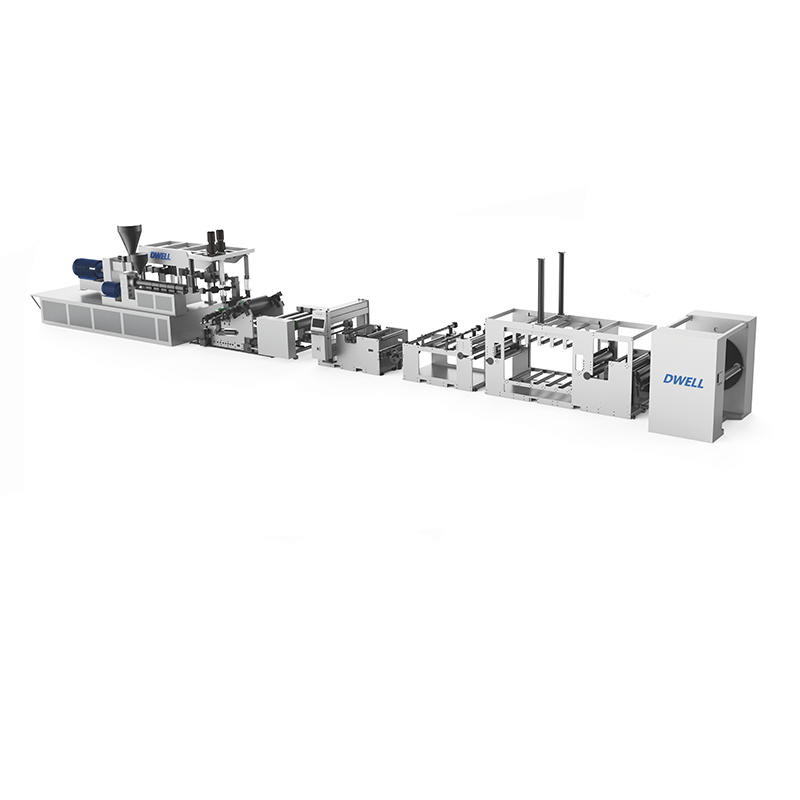


Polypropylene is typically written as PP. It has been a popular material in the flexible packaging industry for many years. Over the past decade, the pursuit of greater optical clarity, enhanced mechanical properties, and more consistent processing performance has led manufacturers to a new generation of production systems: the PP ultra-transparent cast film production line. This type of line is dedicated to producing PP films that have high transparency, gloss, low haze, and a stable dimensionality that is appropriate for advanced packaging, lamination, stocking, and specialty purposes.
Even though cast film technology has been around for decades, the extremely transparent segment is unique because of its natural semi-crystallinity. Getting high transparency from a material that typically forms crystals is dependent on a delicate balancing of molecular design, extrusion control, rapid cooling, and specific winding technology. A manufacturing line that possesses these properties must have a degree of control that resembles scientific instrumentation more than traditional plastic machines.
The PP ultra-sophisticated cast film production line is typically composed of multiple subsystems: high-performance extruders, dosing machines, melt drainage units, flat sheets, corona treatment units, haul-off sections, trimming, slitting, and automation-ready winding stations. Every component has a role, and every role has an effect on the ultimate clarity of the movie.
Those who invest in this type of production line typically seek out markets where the clarity of the product is equal to its value. These markets are characterized by premium packaging, protective film substrates, window film layers, medical packaging, stationery sheets, and multiple-laminate structures that require the PP layer to be imperceptible.
To comprehend the modern-day production of super-transparent cast film in full, it’s beneficial to follow its path from the beginning, which is raw material handling, all the way to the final stretch of precision-wound film.
Raw Material Logic: Why PP Transparency Is Both a Science and an Art
If the goal is to have a clear mind, the journey will start long before the extrusion process. The polymer’s composition must be taken into account and prepared with more care than in the typical processing of PP. The practice of casting super-transparent PP film is typically facilitated by the utilization of special grades of random copolymer polypropylene (PP-R) or clarified homopolymer combined with nucleating agents. These agents that nucleate crystals faster in smaller structures have a faster rate of crystallization, which reduces the haze and improves the transmission of light.
But clarity is extremely sensitive. Even trace contamination from dust, moisture, or incompatible resin can cause streaks, fish-eyes, or cloudiness. For this reason, the raw material system in a PP ultra-transparent cast film production line often includes:
— sealed conveying
— dehumidifying handling
— precision gravimetric dosing
— dust-filtered feeding
— anti-static flow systems
When resin pellets are stored with moisture, the moisture is vaporized during the melting process and forms bubbles. Even small bubbles have an optical effect that is apparent to the end customer. In cases like the packaging of cosmetic goods or superior food wraps, visual flaws can adversely affect the product’s value. As a result, the material system is designed to eliminate any form of pollution, including microscopic ones.
Other components, such as antioxidants, slip agents, anti-blocking materials, and processing modifiers, must be accurately dosed in tenths of a percent. The distinction between a completely transparent movie and a milky movie is derived from a single disparity in composition.
The fixation on clearness inspires a regimen: every gram of resin is involved in the final presentation.
This is the reason why many long-tail queries regarding this field have returned to the same conclusion: the quality of the optical clarity is derived from the raw materials.
Where the Polymer Becomes a Controlled, Transparent Flow
When the resin drops into the hopper of the extruder, it enters a zone where the machinery must handle it with a level of precision that feels almost ceremonial. The extruder of a PP ultra-transparent cast film production line is not simply a large screw pushing melted plastic. It is a thermal and mechanical environment that must balance melting, mixing, devolatilization, and stabilization—all while avoiding thermal degradation.
PP is sensitive to overheating. Even slight yellowing will reduce clarity. Shear heat must be balanced with barrel temperature settings in ways that maintain a stable melt index without causing polymer breakdown.
High-performance extruders used in ultra-transparent cast film lines often include features like:
— multi-zone barrel temperature control
— barrier screw designs
— mixing sections engineered for optical applications
— high-precision melt pumps
— low-pulsation feeding
— real-time pressure feedback loops
— advanced degassing systems (for ultra-low haze film)
The pump that melts is of special significance. Without this, the variation in pressure from the screw would lead to thickness fluctuations across the width of the die. Thickness variations not only lead to an uneven film; they also have an effect on the way light traverses the film, which is detrimental to transparency. As a result, the melt pump imposes a periodic pattern on the flow that is consistent and free of jitter.

The Flat Die: The Heart of Optical Quality
After extrusion, the polypropylene mixture is transferred to a flat die, which is a wide, accurately cut component that forms the mixture into a thin sheet of molten plastic. This is one of the most critical areas of the entire PP cast film production line.
The space between the die and the film’s surface is used to define the thickness of the film with tolerances that are often as accurate as ±1–2 µm. A thermal imbalance in the die’s thermal properties—just a few degrees—can be observed by the naked eye. This is why premium varieties of plants utilize:
— automatic die bolt control
— internal deckling systems
— high-precision heating zones
— polished melt channels
— low-dead-space structures
— streamlined manifolds for smooth flow
At this point, the molten movie appears like syrup: shiny, fluid, and glowing. The difficulty is making sure it lands on the chill roll before the process of crystallization occurs. The quicker the cooling process, the more effective the optical resolution; as a result, the suppression of large crystal formation is beneficial.
Chill Roll Casting: The Moment That Creates Transparency
This part of a PP ultra-transparent cast film production line deserves special respect. The molten sheet lands onto a massive polished chill roll—a steel cylinder internally cooled with water, sometimes oil, to maintain ultra-stable temperature. The chill roll temperature is usually kept in a narrow range (e.g., 18–40°C depending on formula). If the roll is too warm, haze increases. If too cold, surface defects may appear.
The chill roll acts as the sculptor of transparency. When the molten PP touches it, the material freezes into clarity almost instantly. To ensure intimate contact, the system uses:
— electrostatic pinning
— edge bead cooling
— air knives for melt stability
— precision nip rolls
— micro-controlled roll polishing processes
Every component is designed to eliminate air bubbles, ripples, and micro-distortions.
It is common for engineers to say that the optical quality of PP cast film is 70% determined within the first half-second after the melt hits the chill roll. That statement carries both truth and a sense of drama: clarity is a race against crystallization.
Film Handling, Cooling, and Stabilization
Once the film begins its journey away from the chill roll, transparency is already locked into place, but stability is not. Polypropylene wants to shrink as it cools further. Without precise handling, wrinkles, waviness, telescoping edges, or uneven tension would appear. So the production line includes:
— secondary cooling rolls
— micro-perforated air-cooling systems
— tension isolation zones
— edge trimming
— thickness measurement by beta or infrared gauges
The thickness of the cast film is regulated by the thickness control system. This system is considered an unsung hero in the production of super-transparent PP films. Even if the movie is explicit, uneven thickness can lead to optical misconceptions. Modern methods employ closed-loop control: feedback from gauges is immediate and causes changes to the bolts or the extrusion parameters.
Film borders are excised to eliminate uneven flow patterns; the wasted material is often reused in the processing of another film. However, for extremely transparent films, edge trim that is recycled is typically employed in small quantities because even the melted PP may contain haze or gels. Optical clarity is achieved through consistent effort.
Preparing the Surface for Adhesion and Printing
Cast PP film often needs surface treatment so inks, adhesives, and laminating layers can bond properly. Corona treatment uses high-frequency electrical discharge to oxidize the film surface slightly. The process raises surface energy, typically to 38–42 dynes.
For ultra-transparent cast PP, corona must be controlled with finesse:
— excessive treatment causes yellowing
— Insufficient treatment weakens lamination
— uneven treatment forms dull patches
Modern PP ultra-transparent cast film production lines integrate intelligent corona systems with real-time watt density control, temperature monitoring, and automatic gap correction.
Slitting and Winding: Precision Rolls for Precision Film
The final section of the line is the winding system—a deceptively complex operation. Transparent cast film must wind perfectly flat and tight, without telescoping, blocking, or wrinkling. To achieve this, the winder uses:
— automatic tension control
— lay-on roll pressure adjustment
— edge guiding
— shafted or shaftless mandrels
— recipe-based winding logic
Small imperfections that would be imperceptible in dense films become apparent in the transparent counterpart, PP. A scratch, a dusty particle, or an air pocket that is trapped will appear immediately. This is why the technology in this area resembles high-end paper processing more than common film winding.
High-end lines also facilitate automatic winding of the turret without interrupting the line. This facilitates continuous production, which is crucial to industrial settings that have a lack of time will lead to a loss of consistency, clarity, and efficiency.
Applications of Ultra-Transparent PP Cast Film
One reason PP ultra-transparent cast film production lines are gaining global attention is the expanding range of applications that demand both visual purity and mechanical performance. These include:
— cosmetic packaging windows
— premium bakery and confectionery wraps
— flower sleeves
— stationery covers
— adhesive tape substrates
— protective film layers
— clothing packaging
— medical device packaging
— lamination layers in multilayer films
— hygiene product outer wraps
— printing film for labels
In multilayer packaging structures, the transparent PP cast layer often acts as the visual face of the product. If it is cloudy, consumers perceive the entire product as lower quality. Clarity is not merely an optical attribute—it becomes a marketing asset.
Global Trends Driving Demand
Several industry trends are pushing more companies to adopt PP ultra-transparent cast film production lines:
-
Shift toward recyclable mono-material packaging
PP is widely recyclable. With global pressure on sustainability, brand owners prefer packaging structures where most layers are PP. Clear PP cast film fits perfectly into this trend. -
Growth in premium transparent packaging
Consumers associate transparency with freshness, quality, and trust. This is especially true in food packaging. -
Increasing demand for low-haze film in lamination
As lamination structures become more sophisticated, the clarity of the individual layers becomes more important. -
Rise of e-commerce and display-oriented packaging
Clear packaging boosts product visibility online and in stores. -
Advances in polymer chemistry
New random copolymers and clarifying agents allow higher clarity at lower cost.
These trends create a positive cycle of adoption: better materials encourage better machinery, and better machinery encourages wider market use.
Technological Innovation in Modern Production Lines
What separates an ordinary PP cast film line from an ultra-transparent one is a series of engineering innovations behind the scenes.
Extruder Drive Systems
Modern lines use permanent-magnet servo motors, dramatically reducing energy consumption and improving melt stability. Mechanical vibration reduction translates directly into thickness consistency.
AI-Assisted Thickness Control
Although this technology is relatively new, some high-end lines employ machine learning models trained on historical data to predict die adjustments. Notice: this is industrial AI, not text-generation AI—its job is controlling heat and flow, not making language.
Clean-Room-Ready Design
Some factories install these lines inside clean-air environments, especially when producing cast PP film for medical packaging or optical applications. Dust is the enemy of clarity.
Anti-Blocking Technology
Ultra-transparent PP cast film must stay clear without using heavy anti-blocking agents. This requires unique roll polishing, precise cooling, and low-additive formulations.
Integrated Inline Quality Monitoring
Cameras and laser scanners detect gels, streaks, and optical defects. Defect mapping allows real-time root cause analysis.
These innovations show why PP ultra-transparent cast film production lines are not simply machines—they are platforms for precision polymer engineering.
Challenges Manufacturers Must Conquer
While the technology is powerful, ultra-transparent PP cast film production comes with challenges:
— maintaining perfect resin purity
— controlling crystallization during casting
— avoiding melt fracture at high throughput
— keeping thickness variation extremely low
— ensuring stable optical properties across large widths
— preventing micro-scratches during winding
— managing high-speed tension transitions
— reducing haze without overusing additives
Because transparency magnifies imperfections, even minor deviations appear unacceptable.
Why PP Ultra Transparent Cast Film Remains Competitive
Compared with PET or BOPP film, cast PP film has some unique advantages:
— lower cost
— softer hand-feel
— better tear resistance in certain directions
— excellent sealability
— recyclable mono-material compatibility
— lower environmental impact during production
— high flexibility in the thickness range
Its transparency—once the main weakness—has now become one of its strengths thanks to modern production line design.
The future of PP ultra-transparent cast film lies in:
— higher line speeds exceeding 300 m/min
— digital twin integration for predictive maintenance
— new PP copolymer formulations with glass-like clarity
— hybrid cast-stretch systems for improved barrier performance
— advanced automated quality classification
— solvent-free coating, inline integration
— fully closed-loop recycling systems
A PP ultra-transparent cast film production line is far more than a collection of machines. It is a carefully synchronized system of material science, extrusion engineering, cooling physics, surface chemistry, tension dynamics, and winding precision. From the moment raw polymer pellets enter the feeder to the instant the final roll is wrapped for shipment, clarity is being sculpted—molecule by molecule, micron by micron.
