 Skip to content


What is a Board Extrusion Line?
In the huge system of modern industrial production, the Board Extrusion Line (board extrusion production line) occupies a pivotal position. It is like a “magic craftsman” behind the scenes, silently shaping various board products that are everywhere in our lives.
When you walk into the home building materials market and see the dazzling array of PVC plastic boards and wood-plastic composite boards, their birth is inseparable from the Board Extrusion Line. The panels of the kitchen cabinets and the ceiling panels of the bathroom are probably made through this production line. For example, the partition boards in our daily office space and the boards of various display racks in shopping malls are also derived from its “magical processing”. In the field of construction, exterior wall insulation decorative panels, interior decorative wall panels, etc., are also masterpieces of the Board Extrusion Line. These boards have good decorative properties and practical functions such as waterproof, moisture-proof, fireproof, and heat-insulating, which protect our living and working environment.
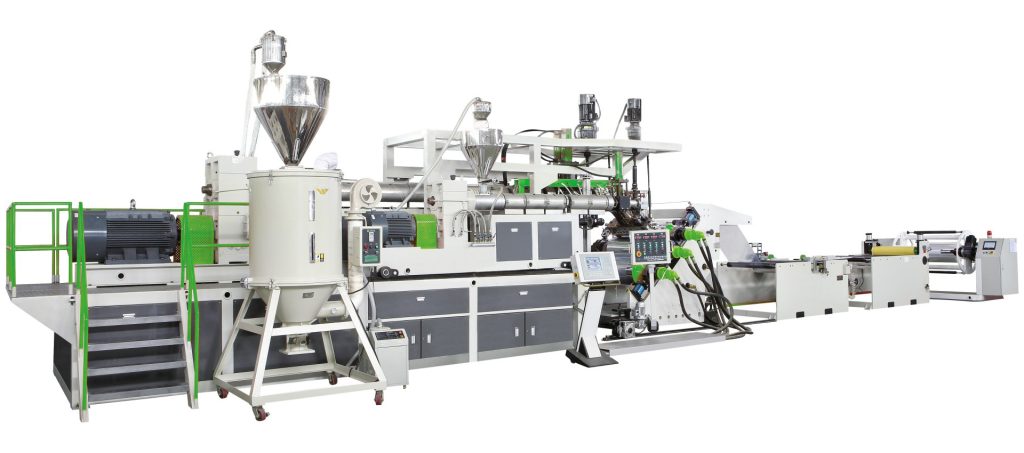
Working Principle Revealed
The working principle of the Board Extrusion Line contains precise industrial logic, just like an orderly production symphony, each link is closely linked, and together they play the movement of high-quality board production.
- Everything starts with the input of raw materials. Common plastic raw materials, such as PVC (polyvinyl chloride), PP (polypropylene), PE (polyethylene), etc., are fed into the hopper of the extruder in the form of granules or powders. These raw materials are like “original notes” waiting to be processed, and are about to start their wonderful transformation journey. For example, when producing PVC boards, PVC raw material particles enter the hopper with their unique chemical properties, laying the foundation for subsequent processing.
- After entering the hopper, the screw begins to play a key role. It is like a hardworking “transporter”, driven by the motor, rotating at high speed, and conveying the raw materials forward along the barrel with the push of the screw thread. In this process, the raw materials gradually approach the heating device outside the barrel, and a wonderful physical change quietly occurs. The heating device outside the barrel is usually composed of multiple heating zones, and the temperature of each heating zone can be precisely controlled according to the characteristics of the raw materials and the requirements of the production process. As the raw materials continue to move forward, they are gradually heated to a molten state, changing from loose particles or powders to viscous fluids with good fluidity, as if awakening from a solid “sleep” and becoming agile, ready for subsequent molding.
- When the raw materials are heated and melted, they enter the key stage of molding – the die mold. The die mold is a cleverly designed component, and its internal flow channel shape matches the cross-sectional shape of the final sheet to be produced, like a tailor-made “magic mold”. Under the continuous thrust of the screw, the molten plastic enters the flow channel of the die mold. Here, the plastic melt is extruded and stretched according to the shape of the flow channel, and gradually shaped into the desired sheet shape. For example, when producing a sheet with a rectangular cross-section, the flow channel of the die mold will guide the plastic melt to form a rectangular slab, just like an artist carefully carving a work of art, giving the plastic melt a specific shape and size.
- After the initial forming of the sheet, it needs to be cooled and shaped to ensure the stability of the shape and the accuracy of the size. At this time, the three-roll calender comes on the scene. The three-roll calender consists of three rollers with smooth surfaces and controllable temperature. They cooperate to calendar and cool the slab extruded from the die head. The slab first contacts the first roller at a higher temperature. This roller plays the role of preliminary compaction and flattening the surface of the slab, making its surface smoother and flatter; then, the slab passes through the second and third rollers with gradually lower temperatures. Under the cooling effect of these two rollers, the plastic slab quickly cools down and solidifies, thereby stably maintaining the shape of the sheet. This process is like putting on a “stable armor” for the sheet, allowing it to enter the subsequent process with precise size and good surface quality. The parameters of the three-roll calender, such as the roller temperature, speed, and gap between the rollers, need to be accurately adjusted according to the material and thickness of the sheet to ensure the quality and production efficiency of the sheet.
- After cooling and shaping by the three-roll calender, the sheet needs to be further cooled and pulled. The cooling device usually uses air cooling or water cooling to further cool the plate to ensure that it is completely solidified. The traction device uses a certain traction force to pull the plate forward evenly to prevent the plate from deforming or piling up during the cooling process. During the traction process, the length and speed of the plate can also be adjusted according to production needs. For example, when producing longer plates, the traction speed can be appropriately increased to improve production efficiency; when producing plates with high dimensional accuracy requirements, the traction speed and tension need to be accurately controlled to ensure that the size of the plate meets the standard.
- Finally, according to the actual use needs, the cutting device will cut the continuous plate according to a certain length or size. There are many cutting methods; the most common ones are sawing, shearing, and hot cutting. Sawing is suitable for thicker and harder plates, which can ensure the flatness of the cut section; shearing is suitable for thinner and softer plates, and the cutting speed is faster; hot cutting is often used for some special materials. By heating the cutting tool, the plate is quickly melted and separated during the cutting process, to obtain a better cutting effect. After cutting, the boards become finished products that can be used directly or further processed. They will be transported to various fields and play an important role in people’s lives and production.

Category subdivision and characteristics
Introduction to production lines suitable for different materials
In the application field of Board Extrusion Line, different plastic materials need to be adapted to specially designed production lines due to their unique chemical and physical properties to ensure the production of high-quality board products.
- For PVC (polyvinyl chloride) materials, its production line has distinct characteristics. PVC has relatively poor thermal stability and is easily decomposed by heat during processing. Therefore, PVC board extrusion production lines pay special attention to precise temperature control. It is usually equipped with a high-performance temperature control system, which controls temperature fluctuations within a very small range through the coordinated work of multiple heating zones and cooling zones. In the screw design of the extruder, the characteristics of PVC are also fully considered, and a special thread structure and aspect ratio are adopted to achieve uniform plasticization and stable transportation of PVC raw materials. For example, some advanced PVC production lines use conical twin-screw extruders, which can achieve efficient plasticization under low shear force, reduce the risk of thermal degradation of PVC, and thus ensure the quality and performance of the sheet. In addition, due to the relatively low fluidity of PVC melt, the head mold flow channel in the production line will be designed to be smooth and have a reasonable size to reduce the resistance to melt flow and ensure the accuracy and surface quality of sheet molding.
- The production line suitable for PE (polyethylene) material focuses on the grasp of its crystallization characteristics and fluidity. PE crystallizes quickly, and the cooling speed needs to be precisely controlled during the production process to obtain the ideal crystallinity and crystal structure, which affects the mechanical properties and appearance quality of the sheet. Therefore, the cooling device of the PE sheet extrusion production line usually adopts efficient air cooling or water cooling technology, which can quickly and evenly cool the sheet to avoid sheet deformation or performance differences caused by uneven cooling. In terms of processing temperature, the processing temperature range of PE is relatively wide, but it also needs to be precisely adjusted according to the specific PE variety. For example, the processing temperature of high-density polyethylene (HDPE) is generally between 200-300°C, while the processing temperature of low-density polyethylene (LDPE) is slightly lower. The production line will be equipped with advanced temperature sensors and heating control systems to monitor and adjust the processing temperature in real time to ensure that the PE melt is molded under the optimal temperature conditions. In addition, due to the good fluidity of PE melt, the design of the die head mold can be relatively flexible, but the dimensional accuracy and surface finish of the flow channel must still be guaranteed to meet the production needs of different specifications of sheets.
- PP (polypropylene) material production lines have different focuses. PP has high crystallinity and rigidity, but it also has the problem of large molding shrinkage. To solve this problem, the PP sheet extrusion production line has unique features in mold design and process parameter control. The mold usually adopts a special structural design, such as increasing the distribution density of the cooling water channel to speed up the cooling speed of the mold, thereby reducing the molding shrinkage of the sheet. In terms of process parameters, parameters such as injection pressure, holding pressure, and cooling time are strictly controlled. For example, appropriately increasing the holding pressure can effectively supplement the volume shrinkage of the PP melt during the cooling process and reduce the shrinkage marks and voids inside the sheet, while reasonably extending the cooling time can make the PP fully crystallized and improve the dimensional stability and mechanical properties of the sheet. In addition, PP needs to be dried before processing to remove moisture and prevent defects such as bubbles during processing. Therefore, the production line is usually equipped with efficient drying equipment to ensure that the moisture content of the PP raw material meets the processing requirements.

Explanation of production lines for different types of sheets
In addition to distinguishing by material, Board Extrusion Line can also be classified according to the type of sheet produced. There are also significant differences in production processes and equipment configurations for production lines of different types of sheets.
- The production line of ordinary solid board pursues an efficient and stable production process. Its production process is relatively conventional, mainly including basic links such as plasticization of raw materials, extrusion molding, cooling and shaping, and cutting. In terms of equipment configuration, single-screw extruders or twin-screw extruders are usually used, and selection is made according to the production scale and quality requirements of the sheet. The screw diameter and aspect ratio of the extruder will be optimized according to the characteristics of the raw materials and the production output to ensure that the raw materials can be fully plasticized and extruded at a stable speed. The design of the die head mold is relatively simple. It is mainly based on the size and shape requirements of the solid board to design the corresponding flow channel structure so that the plastic melt can be smoothly extruded. The cooling and shaping device generally uses a three-roll calender or a cooling water tank. By calendaring and cooling the surface of the board, it can be quickly solidified and obtain good surface quality and dimensional accuracy. The cutting equipment selects the appropriate cutting method according to actual needs, such as sawing or shearing, to cut the continuous board into the required length.
- The core of the foam board production line lies in the realization of the foaming process, which gives the board unique performance advantages, such as light weight, heat insulation, sound absorption, etc. Its production process is relatively complex. In addition to the basic plasticization and extrusion links, it also adds the addition of foaming agent and controls the foaming process. In terms of equipment configuration, the extruder needs to have good mixing performance and be able to fully mix the foaming agent with the plastic raw material. Some advanced foam board production lines use specially designed screw structures, such as screws with special mixing sections, to improve the mixing effect. The design of the die head mold is also more critical, requiring precise control of the pressure and temperature of the melt so that the foaming agent decomposes and produces gas at the right time to form a uniform cell structure. The cooling and shaping device not only cools the board but also maintains the stability of the cells to prevent the cells from rupturing or collapsing. Special cooling methods are usually used, such as vacuum cooling or a combination of air cooling and water cooling. In addition, the foam board production line also needs to be equipped with precise metering devices to ensure that the amount of foaming agent added is accurate, to ensure the consistency of the quality and performance of the foam board.
- The composite board production line focuses on achieving the composite and bonding between different materials to obtain board products with better comprehensive performance. Its production process involves the coordinated processing of multiple materials and requires precise control of the thickness, position, and bonding strength of each layer of material. In terms of equipment configuration, there are usually multiple extruders working at the same time, responsible for the plasticization and extrusion of different materials. For example, when producing PVC composite flooring, one extruder is responsible for extruding the PVC base material, and the other extruder is responsible for extruding the wear-resistant layer and decorative layer materials. Then, these different material layers are compounded according to the design requirements through the composite mold to form a complete composite board. The design of the composite mold needs to consider the compatibility and adhesion of the materials, and adopt a special flow channel structure and temperature control method to ensure that each layer of material can be tightly combined. During the composite process, some auxiliary equipment, such as heating rollers and pressing rollers, is also used to further improve the bonding strength between the materials. In addition, the composite board production line also needs to be equipped with quality inspection equipment to conduct real-time inspection of key indicators such as the thickness of each layer of the composite board and the bonding strength to ensure that the product quality meets the standards.

Wide range of applications
The boards produced by Board Extrusion Line play a key role in many fields with their diverse performance and customizable features, providing strong support for the development of various industries.
- Home construction
In the field of home construction, the boards produced by the Board Extrusion Line are everywhere. In interior decoration, the floor is a part that people frequently touch in daily life. The PVC floor or wood-plastic floor produced by this line has good wear resistance and waterproofness, and can effectively cope with various wear and moisture conditions in the home environment. For example, in areas that are often exposed to water, such as kitchens and bathrooms, these boards can remain stable for a long time, are not easy to deform or rot, and greatly extend the service life of the floor. Wallboards are an important part of interior decoration. The decorative wallboards produced by the extrusion line can imitate the texture and texture of various natural materials, such as wood, stone, etc., adding a unique decorative effect to the interior space. Without using real natural materials, a realistic natural atmosphere can be created, which not only reduces costs but also reduces the consumption of natural resources. The ceiling panels are required to have good fireproof, moisture-proof, and sound-absorbing properties. Gypsum boards and PVC gussets produced by the extrusion line can meet these requirements and provide a safe and comfortable living environment indoors.
In terms of outdoor buildings, roof tiles need to be waterproof and weather-resistant. Plastic roof tiles produced by Board Extrusion Line, such as PVC tiles and ASA tiles, have excellent waterproof properties and can effectively block rainwater penetration. They also have good UV resistance and weather resistance. They are not easy to fade or age under long-term sun and rain, and can maintain good appearance and performance, providing reliable protection for buildings. Exterior wall decorative panels focus on decoration and durability. Exterior wall hanging panels and thermal insulation decorative integrated panels produced by the extrusion line not only have rich colors and diverse shapes, which can enhance the overall beauty of the building, but also have thermal insulation, waterproof, and moisture-proof functions, which can improve the energy efficiency of the building and reduce energy consumption. - Automotive Industry
The automotive industry has extremely high requirements for the performance and quality of materials. The boards produced by the Board Extrusion Line are widely used in both automotive interiors and exteriors. In terms of automotive interiors, the dashboard is the part that the driver directly faces, and it needs to have good touch, aesthetics, and safety. The PP or ABS boards produced by the extrusion line can be used to make dashboards after secondary processing,g such as injection molding. They have good dimensional stability and surface finish, can meet complex design requirements, and also have certain fire resistance to ensure the safety of people in the car. Seat backs and door interior panels need to consider comfort and lightness. The foamed boards or composite boards produced by the extrusion line, such as PU foamed boards, TPU/ABS composite boards, etc., can not only reduce the weight of seats and doors, reduce the overall energy consumption of the car, but also provide good cushioning and support, and improve riding comfort. In terms of automotive exteriors, body panels such as hoods, doors, trunk lids, etc. require boards with high strength, lightness, and good formability. After aluminum alloy sheets or high-strength plastic sheets are produced through extrusion lines, they can be used to make body panels after processes such as stamping and welding. These sheets reduce the weight of the body while ensuring the structural strength of the car body, improving the fuel economy and handling performance of the car. Bumpers need to have good impact resistance and energy absorption. Modified plastic sheets produced by extrusion lines, such as PP modified sheets, PC/ABS alloy sheets, etc., can be used to make bumpers after special structural design and processing technology. They can effectively absorb and disperse energy during collisions and protect the safety of the body and occupants. - Packaging Industry Field
In the packaging industry, sheets produced by the Board Extrusion Line play an important role. Packaging boxes and packaging boxes are important carriers for protecting products and facilitating transportation. PP, PE, or PVC sheets produced by extrusion lines have good strength and toughness, and can be made into packaging boxes and packaging boxes of various specifications and shapes. They can be customized according to the size and shape of the product, fit the product tightly, and provide effective protection to prevent the product from being damaged by collision, extrusion, etc., during transportation and storage. For example, for fragile electronic products, packaging boxes made of extruded sheets can improve the protection of products by adding buffer structures and materials. Pallets are commonly used tools in logistics and transportation, and are required to have strong carrying capacity, durability, and easy handling. Plastic pallets produced by extrusion production lines, such as PP pallets, HDPE pallets, etc., have high strength and rigidity and can withstand heavier goods. They also have the advantages of corrosion resistance, waterproofness, and non-deformation, and have a long service life. Compared with traditional wooden pallets, plastic pallets are more environmentally friendly, easy to clean and maintain, and are also convenient for standardized production and management, which improves the efficiency of logistics and transportation.
Summary and Interaction
As a key equipment in modern industrial production, Board Extrusion Line plays an irreplaceable role in many fields. It not only brings a rich variety of sheet products to our daily lives, but also promotes technological progress and development in various industries. With the continuous innovation of technology and the continuous growth of market demand, Board Extrusion Line has great potential for future development, and is expected to make greater breakthroughs in green environmental protection and intelligent production.
I am very much looking forward to more exchanges and interactions with you. If you have unique insights into the board production process or have encountered interesting problems and challenges in your work in related industries, please leave a message in the comment area to share. Whether it is about the technical details of the Board Extrusion Line or your views on market trends, you can speak freely. I will read every message carefully and reply to everyone promptly. Let us discuss and make progress together.
