 Skip to content
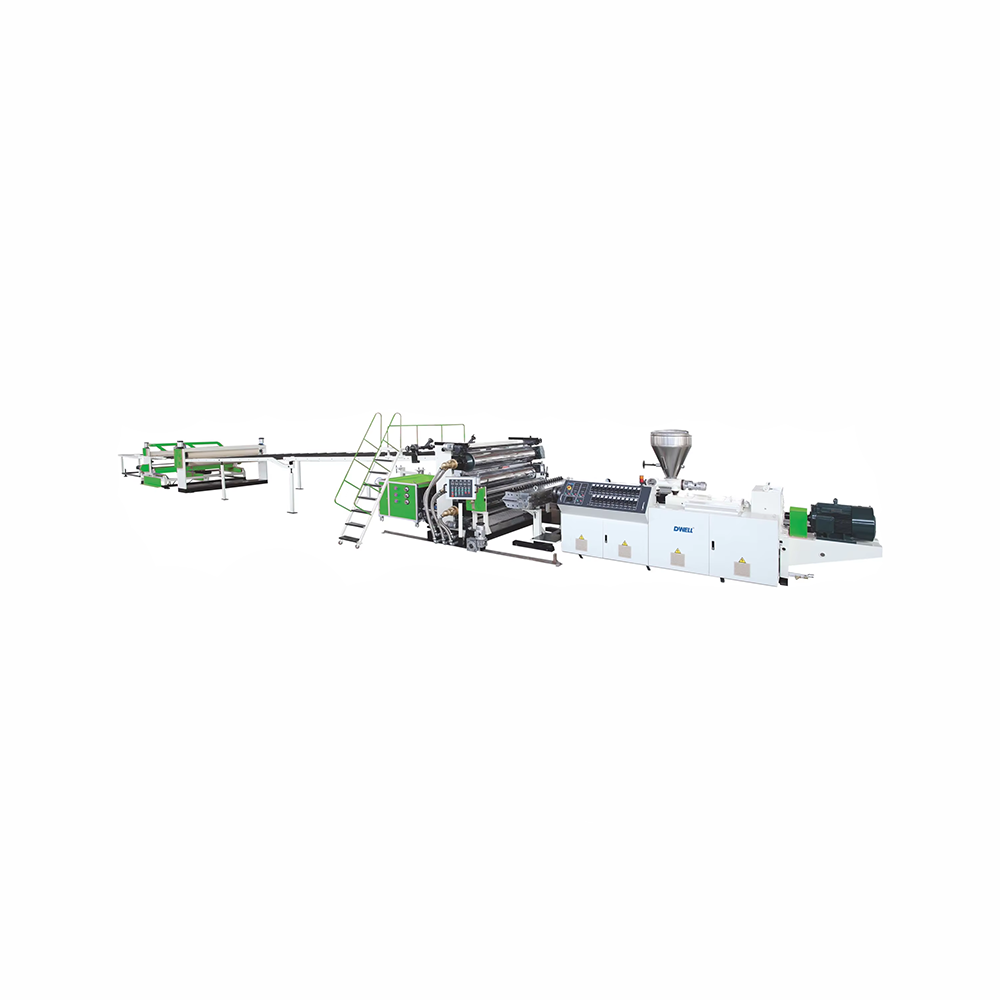


This solution outlines a complete, intelligent manufacturing line for three-layer coextrusion of PETG decorative film, specifically designed to produce high-quality, high-value-added surface decorative films for furniture, cabinet panels, and customized sheets. The fully integrated line combines precision extrusion, intelligent temperature control, online monitoring, and automatic winding to ensure optimal balance among optical performance, mechanical strength, and production cost.
- Raw Material Handling and Precision Extrusion System
This module ensures absolute dryness of raw materials and stable, pure melt output, forming the foundation for producing high-quality PETG products.
Crystallization & Dehumidifying Drying System: Addresses PETG’s hygroscopic nature using twin-tower molecular sieve dehumidification to ensure a feedstock dew point ≤ -40°C, completely eliminating product hydrolysis, embrittlement, and bubbling caused by moisture.
JWS120/33 and JWS65/33 Single-Screw Extruders:
Core Coextrusion Drive: Utilizes a “one large, one small” twin-extruder configuration, the hardware core for achieving three-layer coextrusion.
JWS120/33 (Main Extruder): Typically used for extruding the core layer (B-Layer), which constitutes the main thickness, enabling high output (up to ~500 kg/h) and ensuring production pace.
JWS65/33 (Coextrusion Extruder): Typically used for extruding the surface layer (A-Layer) and bottom layer (C-Layer), precisely feeding high-quality or functional virgin material to ensure surface optical quality and bonding performance.
33:1 L/D Ratio: Optimized screw design and temperature control zones ensure thorough plastification, homogenization, and stable conveying of the PETG melt.
Hydraulic Screen Changer: Enables on-the-fly filter screen changes without stopping production, continuously removing impurities and carbonized particles from the melt, ensuring melt purity—a key factor for producing defect-free film.
Melt Pump: Installed at the extruder outlet, provides constant, pulse-free output pressure and flow for the melt, serving as the core component for ensuring consistent sheet thickness in the machine direction.
- Core Coextrusion Forming and Calendering System
This is the core process zone determining the final product structure, surface quality, and physical properties.
Feedblock and Die:
Feedblock: Precisely channels the multilayer melt streams (e.g., A/B or A/B/C structure) from the two extruders into the coextrusion die.
Multilayer Coextrusion Die: The technological heart of the line. Its internal precision flow channels allow the individual melt layers to combine smoothly before the die lip exit, forming a three-layer sheet preform with clear interfaces and uniform thickness.
Three-Roll Calender and Roll Temperature Control System:
Three-Roll Calender: Typically configured at a 45° incline or horizontally. Responsible for rapidly cooling and setting the molten sheet preform, while imparting the desired surface gloss (glossy/matte) via polished rolls.
Independent Roll Temperature Control System : Provides independent, high-precision temperature control (typically using oil tempering units) for the top, middle, and bottom rolls. Adjusting roll temperatures precisely controls the sheet cooling rate and surface finish.
Drawing Rolls and Cooling Conveyor : Provide smooth traction and further uniform cooling of the sheet after calendering, relieving internal stress and preventing subsequent deformation.
III. Post-Processing, Inspection, and Finishing System
This module performs functional treatment, quality monitoring, and preliminary finishing of the sheet in preparation for perfect winding.
Online Thickness Gauge : Employs non-contact scanning sensors (typically beta-ray) to monitor and feed back the full web width thickness profile in real-time, serving as the “eyes” for achieving high-precision thickness control.
Circular Knife Unit and Edge Trim Wind-Up Station : Precisely trims irregular edges from both sides of the sheet. The trim is automatically wound and collected for recycling, ensuring consistent finished product width and enabling raw material circularity.
Silicone Oil Coating Unit (Optional): Applies an ultra-thin layer of silicone oil to the sheet surface to prevent blocking during subsequent winding and to enhance surface slip.
Corona Treater : Subjects the sheet surface to high-frequency, high-voltage corona discharge, significantly increasing its surface energy (dyne level). This enhances adhesion to inks and adhesives, laying the groundwork for subsequent printing or laminating processes.
Protective Film Laminating Unit (Optional): Used for in-line application of a protective film onto high-gloss surfaces to prevent scratches during winding and transportation.
- Haul-Off, Dancer, and Intelligent Winding System
Ensures the sheet is finally set and wound under stable tension.
Primary and Secondary Haul-Off Units :
Primary Haul-Off : Located after the calender, establishes initial tension to smoothly pull the sheet from the calender rolls.
Secondary Haul-Off: Located after the accumulator, works in concert with the winder to provide the final, most stable pre-wind tension.
The dual haul-off configuration allows for segmented, fine-tuned tension control across the line.
Ionizing Air Blower : Effectively neutralizes static electricity generated on the sheet during high-speed operation, preventing dust attraction that can contaminate the product and improving operational safety.
Accumulator : Positioned between the two haul-off units. Its dancer roll design buffers tension fluctuations, allowing brief non-stop operation for downstream processes (e.g., winder roll change), enhancing the line’s continuous operation capability.
Automatic Turret Winder : Employs a dual-position turret or surface winder, equipped with Automatic Tension Control (ATD) and Edge Position Control (EPC). Enables winding of large-diameter rolls (Φ600-1000mm) with consistent, uniform tension (constant or taper) from core to outside diameter.
- Intelligent Control Core
Complete Electrical Control System : Based on an industrial PLC or distributed control system, it integrates all drives, temperature controls, inspection units, and actuators across the line. A central touchscreen HMI enables “one-touch” operation, process parameter storage, production data tracing, and remote diagnostics, serving as the “brain” for the entire line’s stable, efficient, and intelligent operation.
—
Core Value Summary
This configuration achieves a strategic production model of “using virgin material on the surface for guaranteed quality, and using recycled material in the core for cost reduction” through the three-layer coextrusion design utilizing two extruders. Combined with the complete closed-loop process from precision drying and stable extrusion to intelligent calendering and fully automatic winding, it not only ensures products possess optical and surface properties rivaling those made from 100% virgin material but also reduces comprehensive production costs by 20%-35% through structural optimization, building powerful market competitiveness for our clients.
We provide not just a series of equipment, but a proven, complete solution for the stable production of high-cost-performance PETG decorative film.
Wide Range of Applications: Empowering Diverse Markets
With flexible formulations and process adjustments, our production lines can produce PETG films/sheets to meet diverse needs.
High-End Applications
High-Gloss Piano Lacquer Film: Used for high-end cabinets and appliance panels, presenting a mirror-like, pure effect.
Matte Skin-Feel Film: Used for luxury wardrobes and office furniture, providing a delicate touch and a soft visual appeal.
High-Strength Decorative Sheets: Directly used as self-supporting panels for bathroom cabinets and commercial partitions.
Mainstream and Budget-Friendly Applications
Wood Grain/Stone Grain Decorative Film: Achieves realistic decorative effects through printing and lamination, used for cabinet bodies.
Furniture Back Panel/Drawer Panel Film: Utilizes a high proportion of recycled core materials, providing cost-effective protection and decoration.
Electronic Product Linings and Packaging: Utilizes its high toughness and environmental friendliness.
