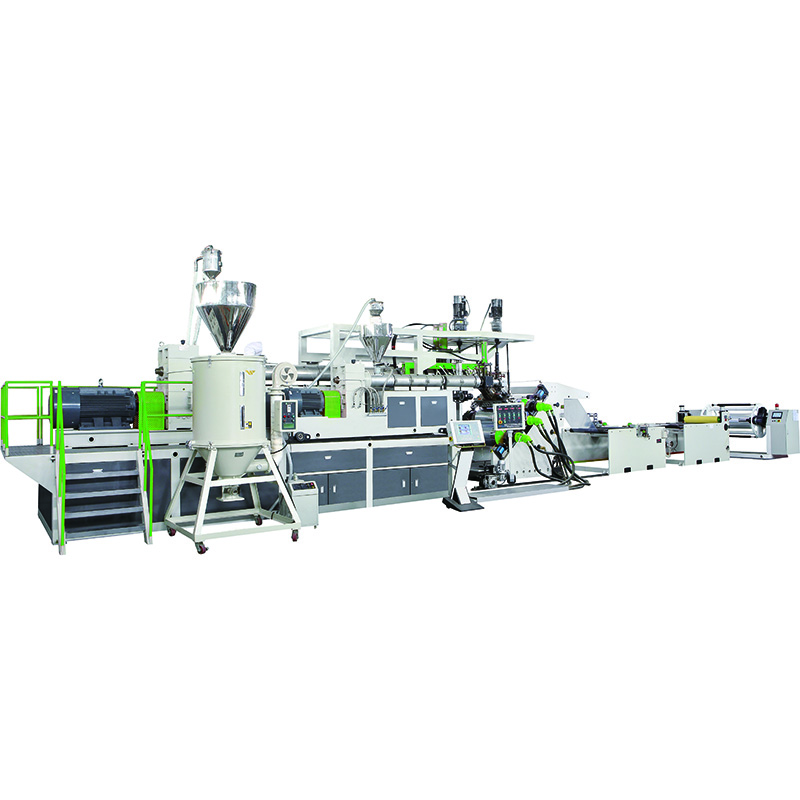
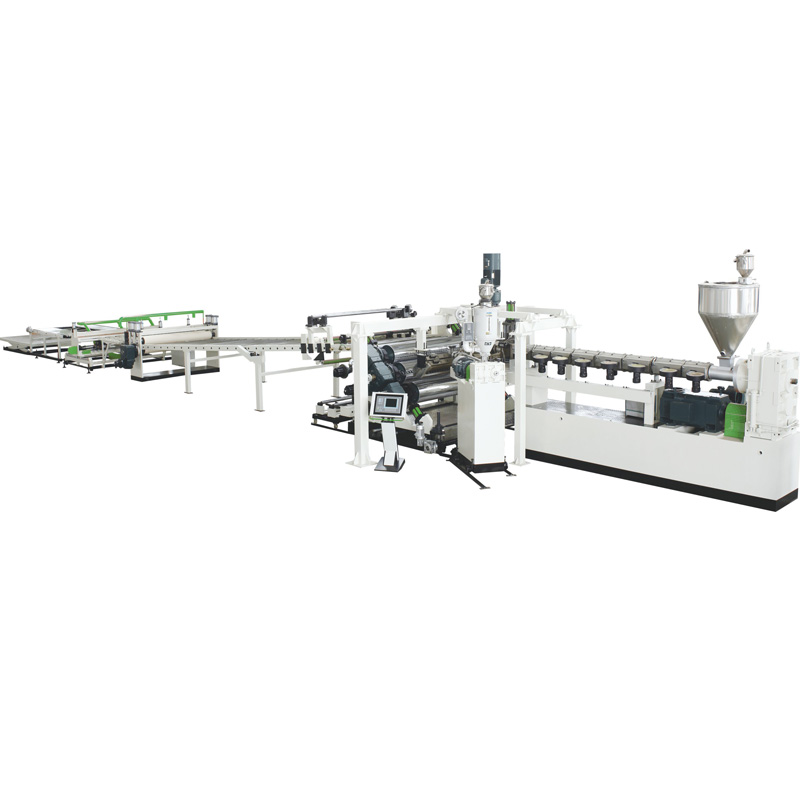
Composition of the sheet extrusion line
①Extruder is the main part of the machine.
The extruder is the core of the production line and consists of a screw, a barrel, a motor, a feeder, a heating device, etc., which is responsible for heating, melting, and squeezing plastic raw materials.
②T-die
T-die Also known as a die, it is a mold with a slit-like discharge port, which is mainly used to squeeze molten resin into a film or sheet. Our company mainly usesthe JC-times brand molds.
③Screen changer
The screen changer is a key melt filtration equipment supporting the extruder and connected in series in front of the die (T-die). Its core role is to filter impurities, rubber particles, and coke in the molten resin to ensure the surface finish and thickness uniformity of the sheet, while protecting the subsequent die and metering components from being worn.
Main types (commonly used for sheet line)
- Plate-type screen changer: simple structure, low cost, manual/semi-automatic switching, suitable for small and medium-sized production capacity, ordinary sheet production lines with low requirements for screen switching efficiency.
- Column-type screen changer: multi-station design, fast screen change speed, minimal pressure fluctuation, suitable for continuous production of high-capacity, high-precision sheets (such as optical sheets, food-grade packaging sheets).
- Double-column screen changer: The sheet line has the highest degree of adaptability, and the two filter columns work alternately to truly achieve seamless screen change without stopping, taking into account the filtration effect and production continuity.
④Melt pump
In the sheet production line, the melt pump is the core voltage regulating and precise metering equipment. It is usually connected in series between the extruder and the screen changer (or between the screen changer and the T-die). The core role is to stabilize the melt pressure, accurately control the melt delivery volume, and ensure the uniformity of sheet thickness and the operating stability of the production line.
⑤Three-roller calender
Three-roller calender: controls the thickness, surface quality, and flatness of the product. The three-roller sheet is mainly 45-degree oblique and 90-degree vertical. The three-roller PET needs a horizontal J-shaped structure because of its good material fluidity.
⑥Roller temperature control system
The roller temperature control system is the core supporting temperature control unit of the three-roller calender. Its core role is to accurately regulate the surface temperature of the three rollers, match the requirements of the sheet melting and setting process, and ensure the surface finish, flatness, and thickness uniformity of the sheet. At the same time, it helps the sheet to quickly cool and set, and is suitable for the continuous operation of the production line.
⑦Cooling bracket
The cooling bracket is an important piece of equipment in the production process of sheets. It is mainly used to further cool and shape the sheets after calendering to ensure the dimensional stability and good performance of the sheets.
⑧Round knife cutting device
Round knife cutting device: responsible for accurately removing unqualified edge materials on both sides of the sheet to ensure that the width of the sheet is consistent and the edges are flat. The core is precisely fixed-width cutting, which adapts to the continuous cutting needs of sheets of different thicknesses and materials, and ensures that the edges of the sheets are free of burrs and crimping.
Core structure
- Tool holder rack: firmly supports the tool set, mostly with a laterally adjustable structure, which is suitable for the width cutting needs of different specifications of sheets.
- Round knife assembly: it consists of two high-precision and wear-resistant round knives, the upper and lower parts; the blade is hard chrome-plated, and the cutting fit is high; the blade can be quickly disassembled and replaced, which is convenient for maintenance and polishing.
⑨Waste edge winding device
Waste edge winding device: it is linked with the round knife trimming unit to simultaneously recycle and cut waste edges, keep the production site clean, realize waste recycling and reuse, and reduce the loss of raw materials.
⑩Tractor
The tractor is the core power conveying equipment from the middle to the end of the production line. Its core role is to provide stable and uniform traction for the sheet, connect the cooling setting, trimming, winding/cutting processes, and accurately control the conveying speed of the sheet to ensure that the sheet is not stretched and deformed, the size is stable, and the entire production line is synchronized to achieve continuous operation.
⑪Winder
The winding machine of the sheet extrusion line is the core equipment at the end of the production line. It undertakes the qualified sheets after traction and trimming, and wraps them into rolls in a regular manner to ensure that the finished sheets have no folds, no tensile deformation, and high edge alignment. It is convenient for subsequent storage, transportation, and secondary processing, and is suitable for the continuous winding needs of sheets of different materials and thicknesses.
Sheet winder specifications: single-station center winder; double-station winder; three-station winder.





.png)